August is when homeschool parents finalize the year: math is chosen, the read-alouds are stacked, and then Bible, the subject that matters most, gets penciled in as "we'll do devotions." By October, "we'll do devotions" has quietly become "we said grace."
Bible time doesn't fail for lack of conviction. It fails for lack of a plan as concrete as the math curriculum's. Here's how to build one in an afternoon.
Decide the year's shape first
A school year is roughly 36 teaching weeks. The Bible's story arc divides beautifully into it:
| Term | Weeks | Focus |
|---|---|---|
| Fall | 1-12 | Creation through the Exodus: the promises |
| Winter | 13-24 | Kings and prophets, then the manger: the waiting |
| Spring | 25-36 | The life of Jesus through the early church: the rescue |
Three terms, one big idea each. When February drags, you're not "on lesson 61 of 180," you're halfway through the waiting, and Easter is coming. Narrative shape is what keeps a year feeling like a story instead of a syllabus.
Then pick your weekly slots
Bible time works best as two or three short touches, not one long block:
- Story day (Monday morning works well): read the week's story, find its message. 10 minutes.
- Activity day (midweek): the hands-on piece — an object lesson, the quiz, the coloring or tracing page for younger kids. 10-15 minutes.
- Table talk (any dinner): one discussion question. 0 minutes of prep.
Write these into your homeschool schedule now, in the same grid as math and reading. Unscheduled subjects are optional subjects, and everyone knows which subject gets dropped first.
Build in the catch-up weeks
Here's the trick veteran homeschoolers use everywhere except Bible, for some reason: schedule only 30 lesson-weeks into your 36-week year. The six spare weeks absorb sick days, the new baby, the moving van, and the week everything simply fell apart. You'll use all six and finish on time anyway, without ever being "behind."
What to actually teach each week
Whatever resource you use, insist on these five parts. They're the difference between Bible time your kids endure and Bible time they ask for:
- The story, short, with its Scripture reference
- The point, one sentence about what it shows us of God
- A check, a few quiz questions (kids love being quizzed far more than being lectured)
- A hands-on piece, something to make, build, or do
- A conversation, one open question with no wrong answer
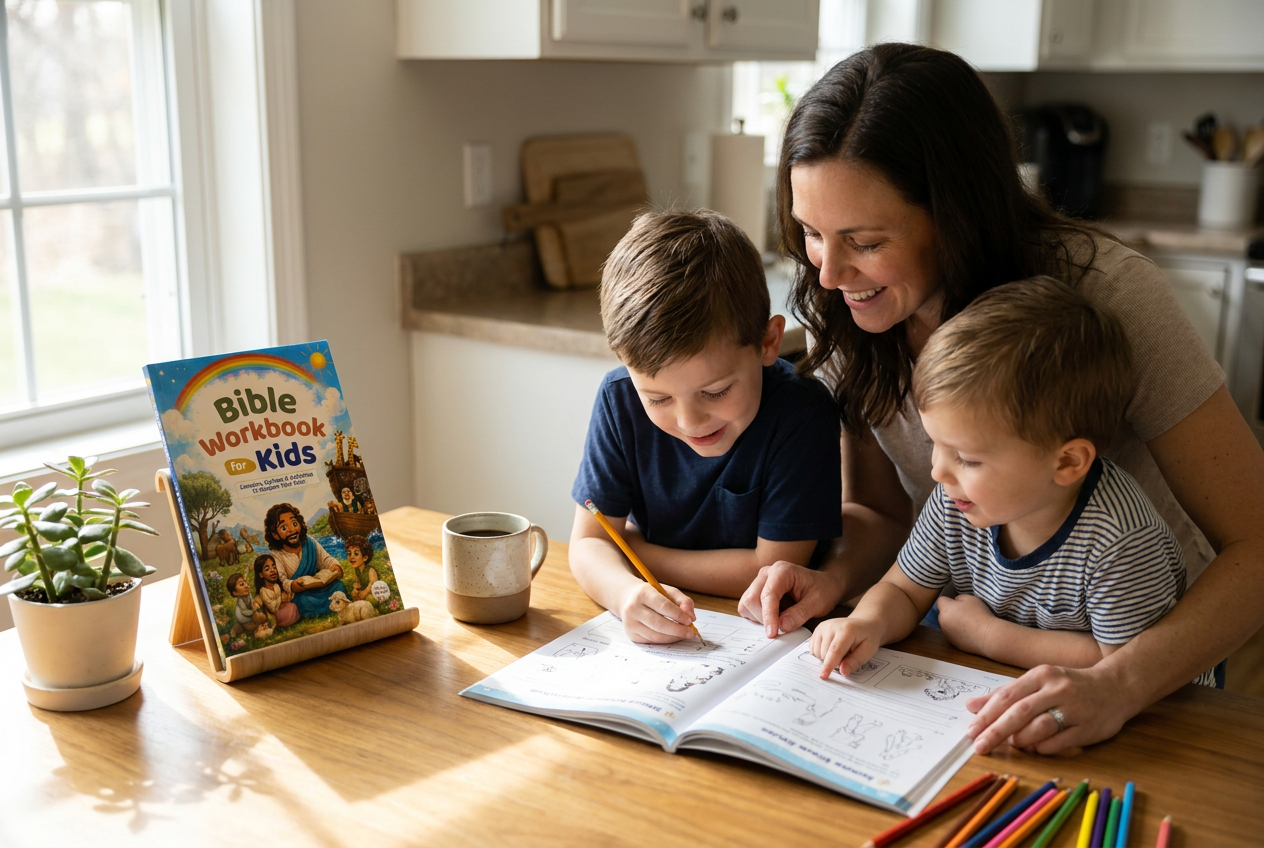
You can write these yourself over the summer. Or, if you'd rather spend that afternoon at the pool, our 52-Week Kids Bible Workbook has all five parts pre-built for every week, 26 Old Testament and 26 New, ages 5-12, ready on the first day of school. Take the 30-week plan above, and the extra lessons become your summer bridge.
The September 1st test
A Bible plan is ready when you can answer three questions: What are we reading in week 1? What day does it happen? Where is the material right now? If the answers are "Creation, Monday at breakfast, on the kitchen shelf," you're done planning. Everything else is decoration.